Hospitals and health systems have been rapidly deploying artificial intelligence in various forms, including ambient documentation, clinical summarization, and administrative automation. AI has helped reduce paperwork and streamline workflows, but its role has largely remained confined to the digital world.
A growing number of IT leaders believe that the healthcare industry’s next major AI transformation will move beyond the computer monitor and into three-dimensional space. This emerging technology, known as physical AI, combines artificial intelligence with robotics, sensors, computer vision, and autonomous systems.
Physical AI in Healthcare
Physical AI has the potential to transport medications, assist surgeons during procedures, monitor patients, guide rehabilitation, and support clinical staff. It could also coordinate hospital logistics while continuously responding to changing conditions. Robotic-assisted surgery is already well-established, and more general-purpose healthcare robots are becoming commonplace in many parts of the world.
The implications of physical AI extend beyond robotics, as it could fundamentally change how hospitals think about automation. Physical AI could shift AI from a passive advisor to an active participant in care delivery, raising concerns about physical safety, human oversight, governance, cybersecurity, and liability.
According to Davit Martirosyan, cofounder and head of engineering at Expper Technologies, physical AI begins when software generates an action in a shared physical environment, rather than just providing an answer. This distinction changes the requirements placed on an AI system, as it must continuously understand its surroundings and account for the unpredictable nature of human behavior.
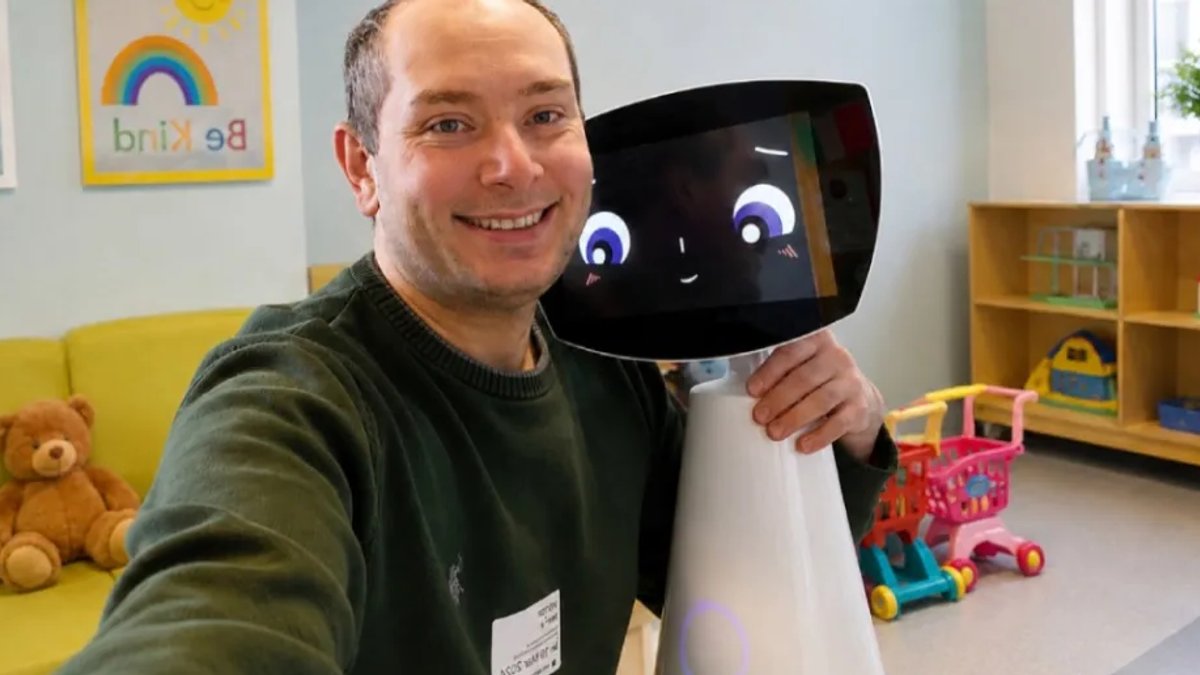
Martirosyan’s company has developed a socially assistive robot called Robin, which has been deployed in pediatric hospitals and senior care organizations. The robot must continuously observe the person’s reaction, adapt, and sometimes recognize that the best action is to pause or allow a human to take over.
Dr. Filippo Filicori, system chief of surgical innovation at Northwell Health, defines physical AI as artificial intelligence connected to sensors, machines, and the physical environment, which can complete a closed loop of perception, planning, and action. He believes that generative AI and physical AI will become complementary components of the same intelligent ecosystem.
David Niewolny, senior director of business development for healthcare and medtech at NVIDIA, frames the evolution of physical AI as the next stage in the maturation of AI tools. He believes that hospitals should think of physical AI as the next wave of AI, which can perceive, understand, and act in the physical world, connecting intelligence to sensors, instruments, devices, rooms, and robots.
Practical Applications of Physical AI
While futuristic images of humanoid robots often dominate public discussion, experts expect healthcare’s earliest successes to come from more practical applications. They foresee hospitals deploying physical AI to perform narrowly defined, repetitive tasks that consume significant staff time, such as transporting supplies, monitoring equipment availability, and supporting patient navigation.
Martirosyan believes that operational work presents the largest near-term opportunity for physical AI, as it can reduce the operational burden and give nurses and other professionals more time for work that requires human expertise. Filicori reaches a similar conclusion, expecting logistics to scale fastest over the next five years, with applications such as supply delivery, pharmacy workflows, and specimen transport.
Niewolny likewise expects logistics, imaging assistance, patient monitoring, and procedural support to become the first widely deployed use cases for physical AI. He believes that physical AI can help close the gap between demand for healthcare services and the available clinical workforce, extending access and increasing the capacity of care teams.
Clinical care is expected to be the area where physical AI will have the most significant impact in the long term, with surgery being one of the strongest candidates due to the structured data generated by robotic platforms. Filicori expects autonomy by task, not autonomy by procedure, to define healthcare’s broader approach to physical AI over the coming decade, with carefully bounded assistance in tasks such as surgery.
Three healthcare leaders agree that physical AI represents the next major frontier for artificial intelligence, and they emphasize the importance of addressing accuracy, reliability, physical safety, human oversight, governance, cybersecurity, and liability as intelligent machines begin interacting directly with patients, clinicians, and the care environment.
Technical Challenges and Opportunities
By automating routine tasks and providing real-time support to clinicians, physical AI systems can help reduce errors, improve patient outcomes, and enhance the overall quality of care.
